- Key Takeaways
- Part 1. E-bike battery comparison: How this guide was built
- Part 2. E-bike batteries compared: 13 options at a glance
- Part 3. Best e-bike battery options: Products and battery formats compared
- Part 4. Best e-bike battery: Engineering criteria for choosing the right pack
- Part 5. E-bike battery suppliers: What to verify before buying or sourcing
- Part 6. FAQs about the best e-bike battery and battery compatibility
Choosing the best e-bike battery is not simply about finding the highest capacity. The right battery must match your bike’s voltage, energy needs, discharge current, mounting space, connector and charging system.
This guide compares 13 e-bike battery products and battery formats, including 36V, 48V and 52V options, to help you understand their differences and choose the right configuration.
Disclosure: Ufine Battery publishes this article and one Ufine product is included in the comparison. Ufine is a lithium battery manufacturer specializing in battery development and customization rather than an independent e-bike review site. Its product is included as a custom battery option, not as a ranked recommendation against the other brands.
Key Takeaways
- Nominal voltage and watt-hours (Wh)
- Lithium-ion or LiFePO4 chemistry
- Downtube, rear-rack, integrated or compact battery format
- Mechanical and electrical compatibility
- BMS and discharge requirements
- Replacement, system-specific or custom battery positioning
Part 1. E-bike battery comparison: How this guide was built
This comparison uses publicly available information from battery manufacturers, brands and product suppliers. We did not purchase or ride-test every battery listed, so the products are not ranked from best to worst.
We compared the options using factors that directly affect e-bike battery selection:
- Nominal voltage and watt-hours (Wh)
- Lithium-ion or LiFePO4 chemistry
- Downtube, rear-rack, integrated or compact battery format
- Mechanical and electrical compatibility
- BMS and discharge requirements
- Replacement, system-specific or custom battery positioning
Specifications can change, so verify the exact battery model and system compatibility before purchasing.
Part 2. E-bike batteries compared: 13 options at a glance
| E-Bike Battery | Reference Specification | Battery Format | Best Fit | Key Consideration |
|---|---|---|---|---|
| Bosch eBike Batteries | Multiple capacities | System-integrated | Bosch-equipped e-bikes | Must match the Bosch eBike system |
| Bosch PowerTube 500 | Approx. 500Wh | Integrated | Compatible Bosch bikes | Not a universal 36V replacement |
| Green Cell 36V 14.5Ah | 36V / 14.5Ah / 522Wh | Downtube Li-ion | Compatible replacement applications | Check rail and connector |
| Green Cell Silverfish | 24V / 11.6Ah / 280Wh | Silverfish Li-ion | Compatible 24V e-bikes | Check mounting and pin layout |
| Ultra Slim Shark | 48V / 11.6Ah | Slim downtube | Frames with limited width | Pack specifications vary by supplier |
| Mini Shark | 48V / 11.6Ah | Compact downtube | Small-frame conversions | Measure usable frame space |
| Dolphin | 52V / 11.6Ah / approx. 603Wh | Downtube | Compatible 52V systems | Controller and charger must support 52V |
| Silverfish 36V 13Ah | 36V / 13Ah / approx. 468Wh | Silverfish format | Older compatible e-bikes | Silverfish is a housing format, not one brand |
| Phylion / Joycube | 36V / 11.6Ah reference | Rear-rack Li-ion | Compatible Joycube systems | Match the original battery code |
| Bafang BT C01 Family | 43V / multiple capacities | Rear-rack system battery | Compatible Bafang systems | Verify the current model number |
| Gazelle Innergy-Compatible | 36V / 13Ah / approx. 468Wh | Aftermarket rear-rack | Specified Innergy systems | Not a genuine Gazelle-manufactured battery |
| Cap Rouge Micro Bottle | 36V / 7Ah / 252Wh | Compact downtube | Space-constrained builds | Lower energy than larger packs |
| Ufine 20Ah LiFePO4 | 38.4V / 20Ah / 768Wh | LiFePO4 battery pack | Engineered battery projects | Not a universal plug-and-play replacement |
Part 3. Best e-bike battery options: Products and battery formats compared
Bosch e-bike batteries: Integrated battery systems
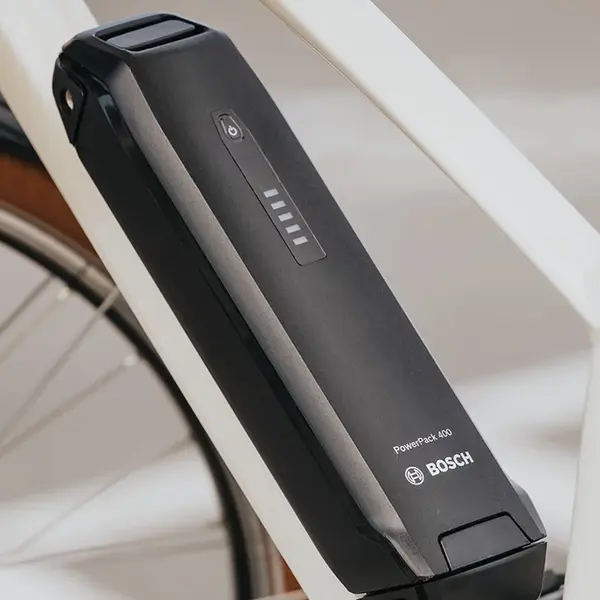
Bosch eBike batteries are designed as part of the Bosch drive ecosystem rather than as universal replacement packs. The portfolio includes frame-mounted and integrated battery configurations in different energy capacities.
Best fit: E-bikes originally designed around a compatible Bosch drive and battery system.
Key consideration: Match the battery to the specific Bosch system and bicycle design rather than choosing by voltage or Wh alone.
Bosch PowerTube 500 e-bike battery: Integrated 500Wh option

The Bosch PowerTube 500 is an approximately 500Wh integrated battery developed for compatible Bosch-powered e-bikes. Its frame-integrated design distinguishes it from generic downtube replacement batteries.
Best fit: Compatible Bosch e-bikes designed for the corresponding PowerTube installation.
Key consideration: An ordinary 36V battery should not be treated as an interchangeable PowerTube replacement because the mechanical and electrical interfaces are system-specific.
Green Cell 36V 14.5Ah e-bike battery: 522Wh downtube pack

The Green Cell 36V 14.5Ah e-bike battery provides 522Wh in a removable downtube format and includes an integrated BMS.
Best fit: Compatible 36V e-bikes requiring a removable aftermarket downtube battery.
Key consideration: Check the mounting rail, connector, controller requirements and available frame space before ordering.
Green Cell Silverfish e-bike battery: 24V 11.6Ah replacement pack

The Green Cell 24V 11.6Ah Silverfish battery provides approximately 280Wh and is intended for compatible electric bicycles using this battery format.
Best fit: Older or replacement e-bike applications designed for a compatible 24V Silverfish battery.
Key consideration: Similar-looking Silverfish batteries can use different connectors, pin layouts and mounting systems.
48V Ultra Slim Shark e-bike battery: Narrow downtube format

The Ultra Slim Shark is a narrow downtube battery format designed for frames where a standard Shark-style enclosure may be too wide. The pictured reference configuration is 48V and 11.6Ah.
Best fit: 48V conversion projects with limited battery width or frame clearance.
Key consideration: “Ultra Slim Shark” describes the battery format, not one standardized pack. Cell type, BMS current, connector and capacity can vary between suppliers.
48V Mini Shark e-bike battery: Compact battery for small frames

A Mini Shark battery uses a shortened downtube enclosure for bicycles with limited frame space. The pictured configuration is a 48V 11.6Ah lithium-ion pack, although other capacities are available in similar housings.
Best fit: Small-frame 48V conversion bikes where a full-size downtube battery cannot fit.
Key consideration: Measure the rail length, battery removal direction and connector clearance as well as the battery dimensions.
52V Dolphin e-bike battery: Higher-voltage downtube pack

The pictured Dolphin battery uses a 52V 11.6Ah configuration, equivalent to approximately 603Wh of nominal energy. Dolphin-style housings are commonly used in removable downtube battery systems.
Best fit: Conversion systems specifically designed around a 52V battery.
Key consideration: A 52V battery requires a controller and charger designed for that voltage. Do not assume it can directly replace a 48V battery.
Silverfish 36V 13Ah e-bike battery: Generic replacement format

Silverfish generally refers to a long removable battery enclosure used by many older electric bicycles rather than to one battery manufacturer. A 36V 13Ah configuration provides approximately 468Wh of nominal energy.
Best fit: E-bikes already using a matching 36V Silverfish battery enclosure and electrical interface.
Key consideration: Verify dimensions, terminals, locking system and charger compatibility because not all Silverfish batteries are interchangeable.
Phylion / Joycube e-bike battery: Rear-rack battery system
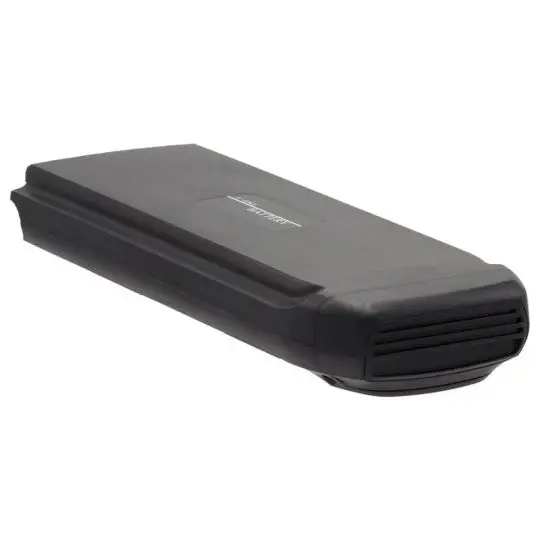
Joycube e-bike battery solutions include lithium-ion battery systems for different electric bicycle configurations. The pictured battery represents a 36V 11.6Ah rear-rack configuration associated with the Phylion/Joycube product ecosystem.
Best fit: E-bikes using the corresponding Joycube or Phylion battery system.
Key consideration: Match the original battery model or system code rather than relying on voltage and capacity alone.
Bafang BT C01 e-bike battery: 43V rear-rack battery family

The original image references the older BT C01.600.UC configuration. Bafang’s current e-bike battery portfolio includes other BT C01 versions, so the image should be treated as a reference to the C01 rear-rack battery family rather than a current-model recommendation.
Best fit: E-bikes designed around a compatible Bafang battery and drive-system interface.
Key consideration: Confirm the current Bafang model number, voltage, energy capacity and mounting interface before sourcing a replacement.
Gazelle Innergy-compatible e-bike battery: Aftermarket replacement

This product is better classified as a Gazelle Innergy-compatible aftermarket battery rather than a Gazelle-manufactured battery. The pictured reference configuration is 36V, 13Ah and approximately 468Wh.
Best fit: Specified Gazelle Innergy bicycles requiring a compatible aftermarket replacement battery.
Key consideration: Compatibility can depend on bicycle generation and electrical interface, so confirm the exact bike model before purchasing.
Cap Rouge 36V 7Ah e-bike battery: Micro bottle downtube pack

The pictured Cap Rouge Micro Bottle battery uses a compact 36V 7Ah configuration with approximately 252Wh of nominal energy. The small enclosure prioritizes frame fit and low battery volume over maximum capacity.
Best fit: Compact conversion projects where a full-size downtube battery cannot be installed.
Key consideration: Its lower Wh capacity means less stored energy than larger 36V packs, so expected range should be evaluated before choosing a compact battery.
Ufine 20Ah LiFePO4 battery: Custom e-bike battery alternative

The Ufine 20Ah LiFePO4 battery has a nominal voltage of 38.4V and 768Wh of energy. Unlike branded replacement batteries above, it is better positioned as a battery platform for engineered or customized applications.
Best fit: Product-development or custom electric mobility projects requiring a purpose-designed battery pack rather than an off-the-shelf replacement.
Key consideration: It is not a universal plug-and-play 36V e-bike battery. Controller voltage, charger profile, BMS, discharge current, connector and mechanical packaging must be matched to the application.
Part 4. Best e-bike battery: Engineering criteria for choosing the right pack
The best battery for an electric bike is the one that matches the complete electrical and mechanical system. Use the following criteria before comparing brands or capacity.
| Selection Factor | What to Check | Why It Matters |
|---|---|---|
| Voltage | 36V, 48V, 52V or system-specific voltage | Must match the controller and charging system |
| Energy | Watt-hours (Wh) | Better for comparing stored energy than Ah alone |
| Discharge capability | Cell and BMS continuous current | Must support controller demand |
| Mechanical fit | Dimensions, rail and removal direction | The battery needs usable installation clearance |
| Electrical interface | Connector and polarity | Same voltage does not guarantee compatibility |
| Charging | Charge voltage and connector | An incompatible charger can damage the battery |
| Battery chemistry | Li-ion or LiFePO4 | Affects voltage architecture, weight and pack design |
Match the e-bike battery voltage
A replacement battery should stay within the voltage range supported by the motor controller. Moving from 36V to 48V or from 48V to 52V may require changes to the controller, display or charger.
For a more detailed look at this voltage class, see the 48V e-bike battery selection guide.
Compare e-bike battery capacity in watt-hours
Watt-hours provide a useful way to compare batteries with different voltages:
Wh = nominal voltage × Ah
For example, a 48V 14Ah battery contains about 672Wh, while a 36V 14Ah battery contains about 504Wh. Actual riding range also depends on terrain, assistance level, speed, rider weight, temperature and motor efficiency.
Check e-bike battery BMS and discharge current
The battery cells and BMS must support the current demanded by the controller. A high-capacity pack is not automatically suitable for a high-current motor system.
Measure e-bike battery dimensions and mounting space
Measure usable frame space, not just the battery dimensions. Shark, Dolphin and bottle-style batteries also need clearance to slide on or off the mounting rail.
Check e-bike battery connectors and charger compatibility
Verify the discharge connector, polarity, charging connector and charger voltage. Batteries with identical voltage and Ah ratings can still have incompatible electrical interfaces.
Choose the right 18650 cells for an e-bike battery
If you are looking for the best 18650 battery for an e-bike, do not compare cells only by mAh. Continuous discharge current, parallel configuration, temperature behavior, cell consistency and BMS design all affect the performance of the finished pack.
Ufine’s 18650 lithium-ion battery options provide examples of cylindrical cell and battery configurations, but a complete e-bike battery still needs to be engineered around the controller and load.
If you are replacing an existing pack rather than designing a new one, the e-bike battery replacement guide covers voltage, dimensions and connector checks in more detail.
Part 5. E-bike battery suppliers: What to verify before buying or sourcing
E-bike battery suppliers can include drive-system manufacturers, replacement-battery brands, battery pack manufacturers and conversion-kit suppliers. Their roles differ, so compare more than price and capacity.
Before buying or sourcing an e-bike battery, verify:
- Exact battery brand or manufacturer
- Battery chemistry and cell configuration
- Nominal voltage, Ah and Wh
- Continuous discharge requirements
- BMS current and protection functions
- Connector and polarity
- Charger compatibility
- Dimensions and mounting interface
- Batch traceability and repeat-order consistency
- Applicable safety and transport documentation
Certification should also be checked against the exact battery model rather than assumed from the supplier as a whole. Ufine’s lithium battery certification information provides examples of available battery compliance documentation.
Part 6. FAQs about the best e-bike battery and battery compatibility
What is the best e-bike battery?
There is no single best e-bike battery for every bike. Choose one that matches the required voltage, Wh capacity, discharge current, mounting system, connector and charger.
Can I replace a 36V e-bike battery with a 48V battery?
Usually not directly. The controller, motor system and charger must all support 48V before changing from a 36V battery.
What is the best 18650 battery for an e-bike?
No single 18650 cell is best for every e-bike. Choose cells based on capacity, continuous discharge current, temperature requirements and the pack’s series-parallel configuration.
How do I know if a Mini Shark battery will fit my e-bike?
Check the battery dimensions, mounting-rail length, removal direction and connector clearance against the usable space inside the frame.
How long does an e-bike battery last?
Battery life depends on chemistry, cell quality, temperature, charging conditions and depth of discharge. Use the cycle-life specification for the exact battery model rather than a universal lifespan estimate.
Related Tags:

More Articles

Best 24V Lithium Battery: Top 10 Compared
Discover the top 24V lithium batteries. We compare capacity, price, cycle life, safety features, and the best options for different applications.
Top LFP Cell Manufacturers in China You Should Know
Looking for reliable LiFePO4 cells? Explore China's top LFP battery manufacturers, key technologies, production capabilities, and supplier selection tips.
Check If Your Charger Works: Simple Test Guide
Think your battery charger's broken? Quick tests can show you for sure. See if it’s the charger or the battery that's causing issues. Read more.
Best Camera Batteries: 7 Brands Compared & Tested
Looking for the best camera battery? Compare 7 top brands, including OEM and third-party options, to find the right battery for your camera.
What You Need to Know About Portable Fan Batteries
Discover the best portable electric fan battery, its types, lifespan, and maintenance tips. Learn how to choose the right one and keep it running longer.